


APRIL 9-10 · BARCELONA
Our Partners








From the stage · Barcelona 2026
Forum Highlights
April 9-10, 2026 · Barcelona
Main Speakers















Insights Report
The ground beneath European politics is shifting faster than at any point since the end of the Cold War. A war on the continent's eastern border. A transatlantic alliance under strain. An energy system being rewired. Artificial intelligence redrawing the labor market. The old certainties about alliances, institutions, and economic models are being tested simultaneously, and the outcomes are not obvious.
In a moment like this, the question of what citizens actually think becomes urgent. The European Pulse exists to answer it: to listen, systematically and at scale, to the people who live with the consequences of the decisions being made on their behalf. Every year. To catch the living beat of European society and to bring that signal into the rooms where policy is shaped. Because in a democracy, the best decisions start with the discipline of asking people what they actually experience.
This first edition surveyed two-thirds of the European Union's population across Germany, France, Italy, Spain, Poland, and Belgium in March 2026 by Cluster17. What those citizens said is the substance of this report.
And what they said is remarkably clear. They want energy independence, even if it costs more (though conviction on cost weakens sharply with income). They want the ability to defend themselves without depending on Washington. They want their data handled by European companies, not American or Chinese ones. They want infrastructure investment. They want a continent that can stand on its own.
These are not fringe positions. In a political environment defined by fragmentation, these numbers represent something close to a continental consensus.
And that is what makes the rest of the data so unsettling.
Because the same Europeans who agree so forcefully on what Europe should become have lost confidence in just about everyone tasked with getting it there. The EU scores 4.1 out of 10 on direction; only one in five Europeans says it is heading the right way. Nearly eight in ten citizens say their government is failing on cost of living. European tech companies, the supposed beneficiaries of digital sovereignty, can't win majority trust in France or Spain. Poland, the most institutionally optimistic country in the sample, still shows 61% dissatisfied with government performance.
That gap between aspiration and confidence is the thread running through every section of this report. Energy, defense, mobility, inequality, technology: in each area, citizens express near-consensus support for the European project and near-universal skepticism about its execution. The mandate is not in question. The capacity to fulfill it is.
Beneath the surface
Two structural findings run beneath the country-level data and surface in every section. The first: party identity is a stronger predictor of European attitudes than nationality. The gaps between parties within a single country consistently exceed the gaps between countries. The data on this is explored in detail in the next section. The second: income is the material base of the divide. The sovereignty project is popular in the abstract, but it is experienced as a luxury good by those least able to afford its costs. In France, the gap between low-income and high-income respondents on whether AI brings benefits is 32 percentage points. In Spain, 36 points.
Poland and France: two mirrors
Two countries define the survey's interpretive boundaries.
Poland is the structural optimist. It is the only country where a plurality says the EU is heading in the right direction. The only country where a majority still sees the United States as an ally. Polish citizens report opportunities their parents never had at a rate of 87.9%, compared to 31.9% in France. Poland's exceptionalism goes deeper than attitude. Across parties, from the governing KO to the far-right Konfederacja, levels of institutional support exceed anything in Western Europe. Poland is the closest approximation in the data to what a European country looks like when the sovereignty project is perceived as working.
France is Poland's inverse. It registers the most pessimistic scores on EU direction, personal outlook, democratic satisfaction, and AI anxiety. It is the only country where a majority fears AI will take their jobs. Its radical left, LFI, opposes the petrol ban at 70.5%, exceeding the far-right RN at 62%. Its Green-aligned voters rate the EU at 2.6 out of 10, more pessimistic than RN supporters. France's despair comes from multiple, mutually incompatible pessimisms layered on top of each other: the left and right hate the system for different reasons, and neither trusts the other's alternative.
These two countries will surface throughout every section of this report. Poland as proof that the model can work. France as evidence of what happens when it doesn't.
What follows
The six sections that follow trace the sovereignty-legitimacy gap across the domains Europeans care about most. Energy. Defense. Mobility. The cost of living. Technology. In each section, the pattern repeats: overwhelming support for the goal, deep skepticism about the path.
Conducted by Cluster17, the European Pulse surveyed 6,698 citizens across Germany, France, Italy, Spain, Poland, and Belgium in March 2026. The fieldwork took place between 13 and 21 March, covering a representative sample by age, gender, socio-economic status, municipality size, and region.
The story it tells is one of frustration. And frustrated publics, historically, do not stay patient forever.
EUROPEAN CLUSTERS

Beyond left and right: how values shape European opinion.
This report analyzes the European Pulse survey not only by country, age, income, and party vote, but also through the lens of sixteen European value clusters developed by Cluster17, a proprietary segmentation methodology that groups citizens by their core values rather than their party affiliation or demographic profile. Traditional political labels (left, right, centre) compress too much. A French green voter and a German green voter may share a party color but diverge on redistribution, immigration, or executive authority. Cluster17's model cuts across those labels. It maps individuals along multiple value axes (economic, cultural, institutional, identity) and assigns them to one of sixteen clusters that recur across all six countries in the sample.
The sixteen clusters, from Multiculturalists to Identitarians, are listed below. Throughout this report, findings are broken down by cluster wherever the data reveals patterns invisible to conventional demographics.
WHERE EUROPE STANDS
And where it thinks it's going.
A continent that can't say it's going right
Ask Europeans to rate the direction of the European Union on a scale from zero to ten, and the continental average comes back at 4.1. Below the midpoint. Forty-one percent say the EU is going in the wrong direction. Only 21% say the right one. The remaining 38% are stuck in the middle, unable to say things are going well but not ready to call them bad. Put it together and nearly four in five Europeans cannot say the EU is heading in the right direction.
France sits at the bottom at 3.5 out of 10, with Italy close behind at 3.8, and nearly half their respondents in the "wrong direction" band. Germany sits slightly above average at 4.2. Belgium at 4.3. Spain matches the EU average at 4.1. And then Poland, at 5.6, the only country above the midpoint, the only one where a plurality says things are heading the right way.
But the 4.1 average masks something more important than the country spread. It masks the party spread.
The transatlantic fracture
Six in ten Europeans now classify the United States as a competitor or a threat. Not Russia. Not China. The United States. The formal NATO ally. The security guarantor of the last seven decades.
Spain leads at 67.4%. Belgium at 66.6%. France at 66.0%. Italy at 64.0%. Germany, with its seventy years of deep structural Atlanticism and tens of thousands of American troops still stationed on its soil, at 62.2%. Only Poland breaks the pattern: 57.8% of Poles still consider the US an ally or partner, a position grounded less in affection than in geography. Poland shares a border with Russia's closest military ally. The transatlantic relationship is not an abstraction there.
The sentiment runs deep. The cluster data confirms it is structurally embedded along ideological lines: among left-leaning Multiculturalists, 93.3% classify the US as a competitor or threat. Among Progressives, 86.1%. Among Social Democrats, 82.6%. Even among right-leaning Anti-Welfare voters, traditionally the most pro-American constituency, 24.6% now see the US as adversarial. Anti-Americanism in 2026 Europe is a left-wing position with near-unanimous intensity. The right remains broadly pro-American, but the consensus is gone.
The reclassification matters because it is not happening in isolation. It sits inside a broader pattern: a continent that wants to stand on its own but cannot find anyone it trusts to lead the project.
The finding the country frame misses
Within Germany, SPD voters rate the EU at 5.7 out of 10. AfD voters rate it at 1.7. That is a four-point gap on a ten-point scale. Between Germany and France, the national average gap is just 0.7 points. Within Poland, KO voters score 7.4 while Konfederacja voters score 3.0: a 4.4-point within-country chasm. Between Poland and France, the gap is 2.1 points.
Party identity explains roughly twice the variance that nationality does.
This reframes how the data should be read. The conventional approach to a six-country poll is national: France thinks one thing, Germany another, Poland is the outlier. And that story has truth in it. But the deeper structure is different. A centrist voter in Warsaw has more in common attitudinally with a centrist in Paris than either has with their own country's radical flank. The European public does not divide primarily along national borders. It divides along ideological lines that cross them.
The AfD profile makes this concrete. AfD voters score EU direction at 1.7. They register 87% "wrong direction." They show 97% dissatisfied with democracy. 98% dissatisfied with government on cost of living. 99% opposed to the petrol ban. No other party in any country comes close to this breadth and intensity of institutional rejection. AfD defines the empirical floor of European institutional trust: the point below which you cannot go. And it anchors one end of a party spectrum that, in every country, produces gaps between voters of different parties that are consistently larger than the gaps between entire nations.
At the other end: KO voters in Poland at 7.4, the only party-level constituency in any country where a clear majority says the EU is heading in the right direction.
The paradox of the pessimistic pro-European
If Europeans are this disappointed in the EU, have they given up on the European project? The data says no.
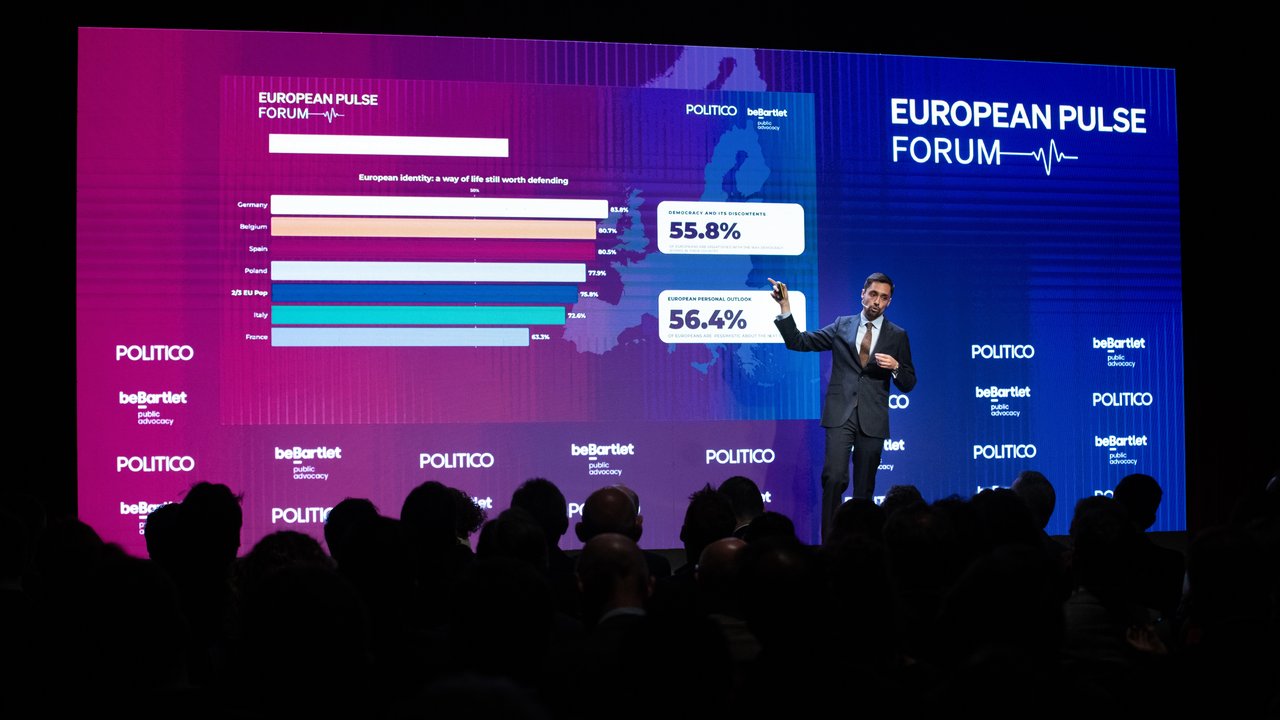
Seventy-six percent affirm a common European way of life worth defending. Germany leads at 83.8%. Even France, the most pessimistic country on most measures, registers 63.3%. When asked whether Europe should become more self-sufficient even at higher economic cost, roughly nine in ten agree across the six-country sample. Spain reaches 94.1%. Belgium 93.1%. Germany 90.9%. Italy sits at 85.6%.
These are not the numbers of a continent turning inward or rejecting its shared identity. The European project retains massive public support as an idea. What it has lost is institutional credibility as a delivery mechanism.
This is the legitimacy deficit. The gap between what Europeans want and what they believe their institutions can provide. It is not Euroscepticism. Three-quarters affirm the European way of life. It is not apathy. The sovereignty numbers are too high for that. It is a specific and consequential form of disappointment: a public united by aspiration, divided by every attempt to fulfill it.
Democracy and its discontents
The institutional disappointment extends beyond the EU. When asked how satisfied they are with the way democracy works in their country, 55.8% of Europeans say they are dissatisfied.
France leads at 66.9%, with 30.5% "very dissatisfied." Poland, the structural optimist, is one of only two countries where a majority is satisfied (51.4%). Germany edges above 50% satisfaction, though barely.
The party data sharpens this further. AfD voters register 96.9% dissatisfied with democracy. Among French abstentionists, the number is similar. But the finding that should give institutional actors pause is that even governing-party voters in most countries show majority dissatisfaction. This is not confined to the protest fringe. It sits in the middle of the electorate.
Personal outlook: the pessimism bloc
Beyond institutions, Europeans are pessimistic about their own lives. The EU aggregate shows 56.4% net pessimistic about the next five years.
Italy leads the despair at 70.2% pessimistic. France follows at 68.1%. Belgium at 67.7%. These three form a Western European pessimism bloc that reappears consistently throughout the survey.
Germany breaks the pattern: 56.7% net optimistic. The "sick man of Europe" story that dominated economic commentary in 2024 and 2025 does not match what Germans report about their own prospects.
And then Poland: 70.3% net optimistic. A near-mirror image of Italy's pessimism. Polish youth (18-34) still register a high 72.8% optimism, but in Poland the 65+ cohort is even more upbeat at 75.1%. French and Italian youth run in the opposite direction.
The income dimension is stark. In Spain, 18.4% of respondents earning under 1,000 euros per month are optimistic about the next five years. Among those earning over 5,000 euros, the figure is 53.6%. A 35-point gap. Optimism in Europe is class-stratified: the sovereignty consensus may be universal, but the personal experience of the continent is radically different depending on income.
What this section tells us
The sentiment data establishes the emotional and political foundation for everything that follows. The pattern will repeat in each subsequent area, energy, defense, mobility, inequality, technology, with local variations but the same underlying structure:
Europeans know what they want. They have lost confidence in every institution tasked with delivering it. That confidence gap is wider between parties within a country than between countries. And it is deepest among those with the least money.
Poland is the exception. France is the rule.
THE CONSENSUS NOBODY CAN DELIVER
Energy has not left the front page since February 2022. Russia's invasion of Ukraine sent prices to historic highs, forced emergency rationing, and exposed a dependency that decades of policy had failed to address. Three years later, just as markets were stabilizing, the escalation in the Middle East has reopened the wound. Supply chains running through the Strait of Hormuz face disruptions whose consequences remain difficult to forecast. Energy bills are rising again. The vocabulary of "energy security" and "strategic autonomy" has hardened into a permanent feature of European political life. In this context, the European Pulse asked citizens what they want. The answers are unambiguous.
Ninety-five point six percent. That is the share of Europeans who say investing more in their own energy infrastructure is important. Germany leads at 98.5%, with nearly eight in ten Germans calling it "very important." Even France, the lowest in the sample, registers 92.2%. At these levels, the word "opinion" undersells it. This is a mandate.
Now place it next to another number: 54.5% of Europeans are not confident in their country's current energy supply. Belgium leads the insecurity at 62.9%. France at 60.1%. Italy at 59.4%. Only Poland, which has spent the last five years aggressively diversifying its supply through LNG terminals and the Baltic Pipe, crosses into net-confident territory at 60.3%.
The distance between those two numbers is the energy trust gap. Citizens have told their governments, with near-unanimity, what they want built. And more than half say it has not been built yet.
A consensus that crosses every line
Energy sovereignty is one of the few policy areas in this survey where ideological polarization nearly disappears. When asked whether Europe should develop its own major energy companies that can compete globally, 92.7% of Europeans agree. Belgium reaches 97.0%. Spain 96.4%. Even Germany, the lowest at 89.8%, delivers a figure most politicians would consider a fantasy mandate on any other issue.
The consensus extends beyond the headline. Above 90% in every country support Europe producing its own energy, even at additional cost. Poland at 97.2%. Spain at 96.7%. Belgium at 96.6%. But the conviction behind that agreement weakens with income. In Germany, only 43.1% of the lowest earners strongly agree, compared to 69.8% of the highest. The consensus is real across the income spectrum. The determination behind it is not.
What is remarkable about this near-unanimity is who shares it. Even the development of European energy champions, a proposition coded in EU institutional language and global competitiveness, draws broad support from voters who elsewhere reject the European project: Eurosceptic clusters agree at roughly 77%, Identitarians at around 80%. But energy infrastructure investment is where ideological resistance genuinely collapses. When the question shifts to physical infrastructure (pipelines, storage, fuel production), Identitarians jump to 91.6% and Eurosceptics to 88.5%.
Consider the AfD. Only 59% of AfD voters agree that there is a European way of life worth defending. Yet 94.3% of those same voters say Europe should invest in its own energy infrastructure. A party whose voters are ambivalent about the very idea of Europe reaches near-unanimity on building European energy capacity. The lesson for policymakers is worth noting: energy proposals anchored in concrete infrastructure will build broader coalitions, reaching all the way across far-right lines, than those anchored in EU jargon.
But the income gradient complicates the ideological story. On the question of EU energy champions, strong agreement rises with income in France (47.8% among those earning under 1,000 euros per month to 74.3% among those earning over 5,000), Germany (26.7% to 58.3%), Italy (56.4% to 78.8%), Spain (51.4% to 74.3%), and Belgium (70.2% to 78.0%). Poland is less linear but still peaks at 100% in the top income bracket, a likely small-sample effect. Net agreement remains high across every income band. The consensus is real. The motivation is different. And when the transition imposes costs, those different motivations will pull in different directions.
The fracture hidden inside the consensus
If everyone agrees on energy sovereignty, where does the argument begin? At the speed of the transition.
When asked about the pace of the renewable energy transition, Europe splits almost exactly in half. Roughly 40% want to accelerate. Roughly 40% want to slow down or simply pursue the cheapest energy regardless of environmental impact. The remaining 20% want to maintain the current pace.
Italy pushes hardest for acceleration at 48.7%, a finding that makes sense once you consider the mechanism: for Italians, decarbonization is first and foremost an energy independence project. A country that imports most of its energy and already faces some of the continent's highest bills sees renewables as a way to cut that dependence. The environmental benefit is secondary to the economic logic.
Germany, on the other hand, shows the highest share choosing "cheapest energy regardless of environmental impact" at 20%. The post-Nordstream trauma of 2022 and the subsequent energy price shock created a constituency that prioritizes cost above all else. Germany's 98.5% on infrastructure importance reads as a security mandate more than a green one, and the two are not always the same thing.
The party data reveals the sharpest divide on energy policy falls here. Grunen voters support acceleration at 91.4%, the highest single-party figure in the entire dataset. AfD voters support acceleration at 6.5%. The green-fossil divide tracks closely along the GAL-TAN axis, with left-libertarian clusters above 80% for acceleration and traditional-authoritarian clusters above 85% against it.
The consensus on what to build is real. The fight over who pays how fast has already begun.
Everyone agrees. But how strongly?
Beyond energy companies and infrastructure. When asked whether Europe should produce its own energy even at additional cost, not a single country drops below 91%. This is the kind of number that, in any other policy area, would end the debate. But look at the conviction behind the agreement and a more textured picture emerges. In Spain and Belgium, more than 60% strongly agree. In Poland, the figure is 54% but the total is the highest in the sample at 97.2%. In France, barely half strongly agree, and the total is the lowest at 91.8%. The direction is shared. The determination behind it is not.
Poland's near-unanimity (97.2%) is striking, but not driven by enthusiasm. Poland also has the widest internal gap in the sample: 97.2% agree, yet only 54.0% do so strongly, the lowest conviction intensity of any country. A 43-point spread between headline support and deep conviction. The mechanism is geopolitical, not aspirational: Poland's proximity to Russia and acute memory of gas dependence produce a broad consensus rooted in threat awareness rather than policy ambition. Poles agree because they feel they must, not because they are excited about the cost. France sits at the other end: the lowest total agreement (91.8%) and similarly modest strong conviction (52.8%), with a 39-point internal gap. Both countries agree. Neither agrees with the same intensity throughout.
And costs have arrived. Place the sovereignty mandate next to the supply confidence data and the gap becomes visible. Europeans overwhelmingly want energy investment. Fewer than half feel confident their country's supply is secure. The distance between those two numbers is the space where political credibility lives or dies.
Belgium's gap is the starkest: 97.3% say investment is important, 37.1% feel confident in supply. Years of nuclear policy reversals have left a mark that persists in public sentiment long after the policy settled. Germany shows a similar pattern: the country that nearly ran out of gas in 2022 now demands investment at 98.5% but trusts its current supply at only 49.4%. Poland is the exception. Its 60.3% supply confidence, the only net-positive reading in the sample, reflects what happens when a government is perceived as actually delivering. The mandate and the confidence align. Everywhere else, they don't.
What the energy data demands
The political implication of this section is straightforward. European governments have explicit public consent to build European energy infrastructure, fund European energy companies, and produce domestic energy. But that consent is conditioned on affordability. The income-intensity gradient running through every consensus question shows lower earners supporting the goals with markedly less conviction, and any mandate that ignores their cost-sensitivity risks fracturing the very coalition it relies on. The conventional wisdom that energy industrial policy is politically risky finds limited support in this data, provided the transition protects those least able to absorb its costs. Across every country and every cluster, the mandate is present. Its depth varies with income.
But the risk runs the other way. Eighty-one percent of Europeans expect the Iran conflict to raise their energy bills. 54.5% already feel insecure about supply. Every percentage point of that insecurity reading is a potential vote against the government in power when the next price spike arrives.
The mandate exists. The question is delivery. And on delivery, 54.5% say it is not there yet.
THE CONTINENT THAT WANTS AN ARMY
For most of the post-Cold War era, European defense was a topic that lived in think tanks, NATO communiques, and the occasional summit declaration. Publics were largely indifferent. Governments spent below their own targets, and the political cost of doing so was zero. The assumption, rarely stated but universally held, was that the United States would always be there.
Russia's full-scale invasion of Ukraine in February 2022 broke that assumption. In the three years since, European defense budgets have surged, conscription debates have returned in countries that abolished it decades ago, and the political vocabulary has shifted from "peace dividend" to "readiness." The question is no longer whether Europe should invest in its own security. The question is whether publics are willing to bear the cost.
The European Pulse provides the most comprehensive answer to date. Europeans back European defense capability at 86.3%. Poland leads at 95.5%. Belgium at 94.7%. Even Italy, the lowest at 81.1%, shows more than four in five citizens agreeing that Europe must develop its own defense. The abstract mandate is overwhelming.
But only 18.6% say they would personally take up arms if their country were attacked. The Europeans who say they back European defense and the Europeans who are willing to bear its most personal cost are different populations. That tension between aspiration and sacrifice runs through every question in this section.
That gap between abstract commitment and personal sacrifice is the defining tension of this section. And it runs deeper than willingness to fight. When income enters the picture, the gap becomes a structural fault line. In Germany, 50.2% of those earning over 5,000 euros a month say defense spending is "not enough." Among those earning under 1,000 euros, the figure is 4.7%. A 45.5-point class gap on the question that will define Europe's security architecture for a generation.
Income emerges as the master variable for defense attitudes. Wealthier Europeans are more hawkish on spending, more willing to fight, more supportive of NATO, and less fatigued by the Ukraine conflict. The defense consensus, like the energy consensus, is universal in direction but sharply class-stratified in intensity.
The defense spending divide
Europe is roughly split into thirds on whether its countries spend enough on defense: 36.9% say "not enough," 36.7% say "about right," and 21.6% say "too much."
Italy stands alone as the only country where the plurality says defense spending is "too much" (38.6%). France is the most hawkish, with 43.9% saying "not enough." Poland, which already exceeds NATO's 2% spending threshold, shows 56.0% saying "about right," reflecting satisfaction with a trajectory already underway rather than complacency.
The party data reveals that the hawkish position sits squarely in the institutional mainstream. Centrist voters say "not enough" at 57.4%. Liberals at 55.6%. Anti-Welfare voters at 70.9%. In Spain, the gap between Vox (86.2% "not enough") and Podemos (3.1%) reaches 83 points, one of the widest party gaps in the defense section. The cluster data confirms a 62.3-point gap between Redistributionists (65.7% "too much") and Anti-Welfare voters (3.4% "too much"), the largest cluster polarization on defense spending.
The Zeitenwende in numbers
Germany's defense transformation, widely discussed in policy circles since the 2022 Sondervermogen speech, now has a public opinion baseline. And the numbers are clear. When asked what they would do if their country were attacked, the response spectrum ranges from taking up arms to considering leaving the country entirely. Germany leads on willingness to fight. France and Spain lead on non-combat support. And in every country, a share of the population would consider emigrating rather than staying.
53.9% of Germans say they would "definitely" defend a NATO ally militarily, the highest unconditional commitment in the sample. 78.2% support mandatory military or civil service. 22.9% say they would personally take up arms, leading all six countries. Germany's 81.9% cost-of-living dissatisfaction (explored in the inequality section) runs in parallel: the security transformation is genuine, not a displacement of domestic economic grievance.
A European army? Yes. But also NATO.
Two in three Europeans support the creation of a European military force (69.5%). Belgium leads at 82.8%, a figure high enough to suggest that the country's multilateral institutional culture has fully absorbed the idea. France, despite elite-level advocacy for European strategic autonomy under the Macron presidency, registers the lowest support at 60.0%. The Macron doctrine has less public backing in France itself than in any other country surveyed.
On defense commitments, Europeans show a subtle but consistent preference for EU-framed over NATO-framed obligations. When asked about defending a NATO ally, 76.0% say yes. When asked the equivalent about an EU member, the figure rises to 80.8%. The 4.8-point uplift is modest but directionally stable across countries. In France, the gap widens to 7.2 points, suggesting that the EU frame activates a solidarity logic that the NATO frame does not fully reach.
Ukraine: the three-way split
On the question of whether Europe provides too much, the right level, or not enough support to Ukraine, Europe splits almost exactly into thirds: 30.0% say too much, 30.6% about right, 34.1% not enough.
The aggregate conceals sharp national and ideological divides. Italy leads war fatigue at 42.0% "too much." Germany is the most hawkish at 44.8% "not enough." The Italian result reflects a specific party dynamic: LSP/Lega voters register 87.7% "too much," and M5S voters are nearly as intense at 82.8%. These are not fringe positions within Italy's party system. Two of the country's largest political movements share war fatigue at levels above 80%, forming a dual-party anti-Ukraine bloc with no equivalent in any other country surveyed.
The ideological pattern is what analysts call a horseshoe. From the radical left: Redistributionists at 63.9% "too much" and LFI at 43.5%. From the radical right: Eurosceptics at 82.2% and AfD at 78.6%. The two extremes converge on the same position from opposite motivations. The radical left opposes support through anti-militarist logic. The radical right through isolationist logic. The institutional centre holds the pro-Ukraine position: Centrists at 65.6% "not enough," Moderates at a near-unanimous rate.
The Ukraine question reveals that the left-right axis has been replaced by a centre-versus-periphery axis on foreign military engagement. The pro-Ukraine coalition is an institutional-centre coalition, not a right-wing one.
The Iran operation: Europe's culture war in numbers
In the third week of March 2026, the survey asked Europeans whether they approve of a military operation involving Iran. The result: 65.9% disapprove across the EU. France is the closest to parity at 46.6% approval. Italy disapproves at 76.2%. Belgium at 72.3%. Spain at 69.8%.
But the country-level data barely hints at what the cluster analysis reveals. The gap between the most approving cluster (Traditionalists at 80.3% approve) and the most opposed (Social Democrats at 0.9% approve) is 79.4 points. This is one of the widest ideological gaps on any question in the entire survey. And even among those who approve, the question of how far to go produces its own fractures: only 12.6% of Europeans support military involvement, while 21.9% would limit their country's role to diplomatic support. The majority prefers to stay out entirely.
The Iran question is not a foreign policy debate in any conventional sense. It is a proxy for a deeper cultural and ideological divide. The clusters that approve (Traditionalists, Conservatives, Anti-Welfare) are the security-hawkish, authority-positive right. The clusters that disapprove at near-total rates (Social Democrats, Progressives, Multiculturalists) are the institutional-left. The question maps onto the liberal-conservative cultural axis with unusual precision. Iran is a Rorschach test for European geopolitical identity: the same question, viewed by different ideological groups, reveals entirely different pictures of what Europe should be and what role it should play in the world.
France's near-parity on this question (46.6% approve) appears driven by its large hard-right political constituency (REC at 82% approval) rather than any broad cross-partisan consensus. France is not more hawkish on Iran because French public opinion has converged. It is more hawkish because its right flank is larger.
The energy bill beneath the geopolitics
Eighty-one percent of Europeans are concerned that the Iran conflict will raise their energy bills. Spain and Italy lead at 89.7% and 89.6% concerned. Even France and Germany, the least worried, register above 72%.
The cluster analysis reveals this is the question where ideological polarization nearly vanishes. The gap between the most and least concerned clusters is just 20.8 points, the smallest cluster gap in the entire survey. Authoritarians lead at 92.1% concerned. Moderates are lowest at 71.3%. But even the most relaxed cluster shows nearly three-quarters of its members worried about energy costs.
This finding bridges the defense and energy sections. The geopolitical and the economic are not separate anxieties. They are linked through the energy supply chain. Populations that disagree on everything, Ukraine support, conscription, the Iran operation itself, converge absolutely on fearing its energy cost. The Iran question lands differently when the electricity bill arrives.
Conscription: the generation gap
Two in three Europeans support mandatory military or civil service (66.1%). Germany leads at 78.2%. Spain is the only country where a majority opposes (53.7%).
The Spanish result is structurally interesting. Spain shows relatively hawkish positions on Ukraine support and defense spending but rejects conscription. The pattern is consistent: the Spanish public wants more defense, more military action from others. It does not want to serve itself.
The age gradient sharpens the finding. In France, 79.0% of those over 65 support mandatory service. Among 18-34 year-olds, the generation that would actually serve, the figure drops to 53.4%. A 25.6-point age gap. The people most supportive of conscription are those least likely to be conscripted.
What the defense data tells us
The defense section contains the survey's sharpest polarizations and most complex cross-currents. An 86.3% consensus on capability coexists with an 18.6% willingness to personally fight. A 79.4-point ideological gap on Iran coexists with a 20.8-point consensus on energy bill concern. Germany's Zeitenwende is real in the data. Italy's drift away from Western defense consensus is equally real.
The income finding runs through all of it. Defense hawkishness rises with income. War fatigue rises with economic precarity. Combat willingness rises with wealth. The populations most resistant to bearing the cost of European defense are the same populations most exposed to the consequences of not having it. That contradiction has no institutional solution yet.
DON'T BAN IT BUILD IT
How people move through their daily lives is where European policy meets the pavement. The 2035 ban on new petrol and diesel cars was designed as a flagship of the Green Deal, a regulatory signal that the transition was irreversible. But between Brussels and the school run, something got lost. Fuel prices that spiked with the war in Ukraine never fully came back down. Charging infrastructure remains unevenly distributed across regions and income levels. And for millions of Europeans, especially outside major cities, the car is not a lifestyle choice but the only way to get to work. The mobility section of the European Pulse captures a public that wants the transition but rejects the instrument chosen to deliver it.
Fifty-eight percent of Europeans oppose the EU's plan to ban the sale of new petrol and diesel cars by 2035. In the same survey, 65% support investing more public money in public transport, even if it requires a tax increase. Same Europeans. Opposite majorities.
Belgium leads the opposition to the ban at 72.4%. Germany at 59.6%. Spain at 59.4%. France at 59.3%. Italy, the least opposed, still registers 55.3%. Majorities against in every single country. But flip the frame from "we will ban" to "we will build," and the picture reverses. Italy supports public transport investment at 70.8%. Poland at 69.2%. Spain at 68.1%. Even Belgium, the strongest ban opponent, supports the transport investment at 56.0%.
The transition itself is not rejected. The instrument is.
This is the investment-over-mandate preference that runs across multiple sections of this survey. Citizens endorse public provision at higher rates than they endorse regulatory prohibition. They are not opposing change. They are opposing the specific mechanism that removes consumer choice without providing an affordable alternative. The 2035 petrol ban asks people to stop doing something. Public transport investment offers them something to start.
The most polarized policy question in the survey
If the ban-vs-investment contrast tells the aggregate story, the party data reveals why the ban has failed politically. The petrol ban produces one of the two largest party-level polarization gaps in the entire survey.
In Germany: Grunen voters support the ban at 93.6%. AfD voters support it at 1.1%. A 92.5-point gap. For context, the maximum country-level gap on the same question is 19.6 points. The party gap is nearly five times the country gap.
The split runs deeper than left versus right. Mobility has become a culture war encoded in transport policy. And it does not follow the lines that Brussels-level discourse assumes.
The LFI paradox: when the working class breaks with its own side
In France, LFI voters oppose the petrol ban at 70.5%. RN voters oppose it at 61.9%. The radical left opposes the EU's flagship green mandate more intensely than the far right.
This is one of the most politically consequential findings in the mobility section. The ban was designed as a progressive climate policy. It requires a progressive political coalition to survive. In France, that coalition has fractured. LFI's economic populism overrides its ideological alignment with the green transition. The LFI voter profile is economically precarious, concentrated in sectors where car ownership is not a lifestyle choice but a work necessity, and the ban reads to them as a cost imposed by elites who have alternatives they do not.
The LFI-EELV gap on the ban is 21.9 points (LFI 29.5% favorable vs. EELV 51.4% favorable). But it is not just LFI. EELV itself only musters bare-majority support (51.4%), a figure far below the 83-93% levels that Green voters produce in Germany and Belgium. The entire French party system has shifted against the ban. PS/PP shows 69.4% favorable, but Renaissance drops to 56.9% and LR to 56.5%. France's radical left is internally at war on climate policy, but even France's moderate greens are tepid. The LFI position is not isolated: it shows up again on Chinese EVs (70.9% negative, making LFI voters among the most protectionist in France) and on immigration (70.3% restrictive). Economic cost-sensitivity, not ideology, is driving LFI positions across multiple domains.
The contrast with Spain is instructive. Spain's left is cohesively pro-ban: Podemos at 83.1%, Sumar at 74.5%, PSOE at 70.2%. The Spanish left has not experienced the same fracture between green politics and economic populism. In Germany, SPD voters support the ban at 59.7%, putting them in a different category from Grunen (93.6%) but still well above CDU/CSU (31.1%) and AfD (1.1%). France's left is the outlier. But France is Europe's second-largest economy, and what happens there matters.
Education, not income, is the strongest predictor
On the petrol ban, education surpasses income as the most consistent demographic predictor. In Belgium, the gap between low-education and high-education support runs 24.7 points. In Germany, 21.8 points. In France, 19.4 points. Higher education correlates with ban support across every country, likely operating through both knowledge channels (understanding of climate science and transition economics) and value orientations (cosmopolitan openness, environmental priority).
Italy produces the most counterintuitive demographic finding. Lower-income Italians are more supportive of the ban than higher-income ones: 53.5% favorable among those earning under 1,000 euros, dropping to 29.8% among those earning over 5,000. This income inversion has no parallel in the other five countries. The mechanism appears to be that for low-income Italians who already pay heavily for petrol and face some of the continent's most expensive fuel bills, banning petrol cars reads as banning the thing that is already hurting them. Decarbonization, for this constituency, is economic relief disguised as climate policy.
Chinese EVs: France stands alone
The survey asked whether the entry of cheaper Chinese electric vehicles into the European market would be positive or negative. The EU aggregate is net positive at 54.9%. Spain leads at 66.4%. Poland at 64.4%. Germany at 57.0%.
France is the only country with a net negative view: 63.6% see Chinese EVs as negative. And the party data deepens the finding: RN at 83.4% negative. LFI at 70.9%. PS/PP at 60.3%. Even Renaissance at 57.3%. French protectionism on Chinese EVs amounts to a national consensus, with only EELV (58.6% positive) as a partial exception.
Germany's net positive view (57.0%) is counterintuitive given that its automotive sector competes directly with Chinese manufacturers in the EV mid-market. German consumers appear to prioritize affordability over industrial protection, a preference that the country's automakers may find puzzling.
Autonomous vehicles: a divided continent
On self-driving vehicles, Europe is genuinely split. 42.2% say they would feel comfortable, with no country reaching a clear majority of support. Italy comes closest at 50.3%, effectively parity. France is the most resistant at 31.8%.
The autonomous vehicle question is worth noting less for what it reveals about transport policy and more for what it does not reveal: no demographic or party predictor produces consistent patterns across countries. Podemos voters in Spain register 83.0% uncomfortable, the highest party-level discomfort. German FDP voters register 69.7% comfortable, the highest. Autonomous mobility does not yet have the ideological or material structure that the petrol ban has developed. It remains a genuine unknown.
What the mobility data tells us
The mobility section delivers the clearest version of a pattern visible across the survey: citizens do not reject policy goals. They reject specific instruments. The petrol ban and the public transport investment target the same objective, reduced car dependence and lower emissions, through different mechanisms. One is rejected by majority. The other is endorsed by majority.
For policymakers, this is not an academic distinction. Any government that reframes its mobility transition from prohibition to provision is better aligned with where public opinion already sits. The 92.5-point party gap on the ban and the LFI paradox in France confirm that the current instrument has lost its cross-ideological coalition. The investment approach retains one.
THE BILLS THAT DON'T WAIT
Cost of living has become the defining domestic issue across the continent. Housing costs have dominated political agendas from Berlin to Lisbon. Energy prices, which spiked with the Russian invasion and are rising again with the Iran conflict, have squeezed household budgets from both ends. Food inflation, quieter in the headlines but persistent in the shopping basket, has not retreated to pre-2022 levels. The European Pulse captures how citizens rank these pressures in March 2026, a moment when energy supply disruptions from the Middle East are actively pushing bills upward.
When asked which cost they find most difficult to manage, Europeans cite three burdens that together account for over 70% of responses. Energy leads at 28%, housing follows at 22.5%, and food and groceries at 20.2%. The remaining categories (healthcare at 12.4%, transport at 9.1%, education at 6.6%) sit well below. The top three form a cluster of acute, daily-life financial pressure. The rest are second-tier concerns.
Energy's position at the top reflects the moment as much as the structure. The Iran conflict's impact on supply chains has pushed energy bills back to the center of household anxiety, connecting directly to the 81% concern figure from the defense section. But housing pressure is structural, not cyclical: it persists across economic cycles and will likely outlast any single geopolitical shock. Both are severe. The ranking between them may shift with the next price movement.
Nearly one in four Europeans (24.2%) report no difficulty at all. Germany stands out at 33.3%, the highest share in the sample. German financial stress is lower than any other country surveyed. But this comfort is unevenly distributed: it concentrates in higher income bands and among older, more educated populations. The 24.2% who feel no pressure are not a cross-section of Europe. They are a specific demographic subset. This makes Germany's next data point all the more revealing.
Every government is failing
Seventy-eight point four percent of Europeans are dissatisfied with their government's response to cost of living. France leads at 84.8%. Italy at 81.3%. Germany at 81.9%.
Germany's figure deserves a second look. Only 32.3% of Germans report personal financial difficulty, the lowest in the sample. Yet 81.9% are dissatisfied with their government's performance on cost of living. A 49-point gap between lived experience and institutional evaluation. Germans are less personally squeezed than the French or Italians, but equally furious at the institutional response. The Ampel coalition collapse and political turmoil of 2024-25 likely contribute to an institutional performance evaluation that operates partly independently of personal material conditions.
Even Poland, the survey's structural optimist, shows 61.4% dissatisfied. The dissatisfaction signal is present in every country, every income band, and even among institutionally-aligned clusters. Moderates and Centrists, the clusters closest to the institutional mainstream, show majority dissatisfaction with cost-of-living response. The signal is structural, present across every segment of the electorate.
The party data confirms that government satisfaction is the most party-determined question in the survey. In Spain, 35.5% of PSOE voters (governing party) are dissatisfied, compared to 100% of Vox voters. In Italy, FdI voters (governing party) show 62.0% satisfied; M5S voters show 97.9% dissatisfied. The gap between governing and opposition voters is larger on this question than on any other, suggesting that cost-of-living evaluation is as much a judgment on incumbency as on material conditions.
Education adds a final layer to the dissatisfaction story. In Germany, the gap between the least and most educated is the widest in the sample: 91.2% dissatisfied among those without a high school diploma, compared to 74.2% among those with five or more years of post-secondary education. A 17-point spread. In Belgium, the pattern holds at 73.3% vs 58.5%. But in Italy and Poland, the gradient inverts: the most educated are more dissatisfied than the least educated, suggesting that higher education raises expectations of government performance rather than lowering frustration. Education does not insulate from dissatisfaction. In some countries, it amplifies it.
The generational fracture
When asked whether they have more or fewer economic opportunities than their parents, Europe splits narrowly: 47.7% say more, 52.0% say fewer. The aggregate hides the sharpest bilateral contrast in the entire survey.
Poland: 87.9% say more. France: 31.9%. The gap is best understood through the reference point each country's respondents carry.
Polish parents grew up under state socialism. The 1989 transition, EU accession in 2004, and the rapid economic convergence of the last two decades make almost any contemporary outcome look like progress. French parents grew up in the trente glorieuses and the social elevator that followed. The comparison is to a golden age that today's economy has not replicated.
But the age dimension within France is what should stop policymakers. Among French 18-34 year-olds, 8.2% say they have more opportunities than their parents. Fewer than one in ten. In Italy, the youth figure is 7.3%. These are not pessimistic numbers. They are a generation that has written off the social contract.
In Poland, by contrast, 84.5% of youth say "more." Even the young are overwhelmingly positive about their trajectory. The Polish generational consensus is not age-dependent; it is structural, grounded in a national experience of rapid improvement that transcends generational divides.
The party data darkens the French picture further. Even Renaissance voters, the governing party that stakes its identity on pro-European reform, register only 43.9% saying "more." Below majority optimism. RN voters sit at 43.0%, nearly identical. The pessimism in France is not a left-right divide on this question. It is systemic. Only LFI stands out as markedly more pessimistic at 29.4%, the deepest pole in the French party system. In Poland, even Konfederacja, the far right, shows 67.7% "more." Polish optimism holds across every party. French pessimism holds across every party too. The difference is which floor each country is standing on.
Half the doors on your street can't cover the basics
Four in ten Europeans say covering daily costs is difficult. France leads at 47.8%. Italy at 46.2%. Germany at 32.3%. Spain at 32.1%.
France and Italy occupy a different economic reality from Germany and Spain. Nearly half of French and Italian respondents report difficulty, a figure that reflects not just current prices but accumulated pressure from years of stagnant wage growth against rising housing, energy, and food costs. Germany's 32.3% is the lowest in the sample, yet as the next subsection shows, German institutional dissatisfaction runs just as high as France's. Spain at 32.1% is striking for a different reason: this is the country where 89.7% are alarmed about energy bills from the Iran conflict. The fear of what is coming and the experience of what is already here are not the same thing, and Spain captures that distinction precisely.
The income gradient on daily cost difficulty is the steepest in the survey. In Spain, 73.8% of those earning under 1,000 euros report difficulty, compared to 9.9% of those earning over 5,000. A 63.9-point gap. In Italy: 77.3% vs. 15.3%. In Germany: 67.8% vs. 12.5%. The ability to cover basic costs is the most income-predictable response in the dataset.
The shape of the income curve matters as much as the gradient. In Italy and Belgium, the drop from the lowest to the highest income band is nearly vertical: 77.3% to 15.3% in Italy, 78.6% to 9.3% in Belgium. The middle-income bands in both countries show sharp declines, suggesting that the squeeze concentrates at the lower end with limited cushion in between. France shows an unusual pattern: the 1,000 to 1,500 euro band reports higher difficulty (74.6%) than the under-1,000 band (57.8%), a bump that points to a specific cost-of-living trap where earnings are just high enough to disqualify from social support but too low to absorb price shocks. Poland's curve is the flattest and the lowest, consistent with the structural optimism that runs through every section of this survey.
Income explains who struggles. But education shapes how that struggle translates into political behaviour. The relationship between education, financial difficulty, and institutional trust is not linear. Higher education correlates with lower financial stress, but it also correlates with different expectations of government and different thresholds for dissatisfaction.
The cluster data reveals the political dimension. Authoritarians (65.5% difficulty) and Eurosceptics (64.7%) are the two most financially stressed clusters. The two most anti-establishment blocs in the survey are also the most materially precarious. Moderates report 19.8% difficulty. The 45.7-point gap between the institutional centre and the anti-establishment periphery is not coincidence. Economic precarity and anti-institutional politics are structurally linked.
The M5S voter profile sharpens this further. M5S voters in Italy report 69.0% financial difficulty, the highest single-party constituency on this question in the entire dataset. AfD voters report 49.3%, the most financially stressed German party, a figure that exceeds the French national average. The anti-establishment voter base is materially suffering, and the politics follow from there.
This is the material base of the legitimacy deficit. The gap between institutional aspiration and institutional trust that runs through every section of this report is not an attitude. It is a condition. The populations that most distrust European institutions are the populations most exposed to the economic pressures those institutions have failed to relieve. Inequality is not a separate policy problem from the trust crisis. It is the same problem, measured in different units.
Immigration: Belgium leads the restrictive turn
On immigration, 46.1% of Europeans favour reducing or sharply reducing immigration levels. 38.4% prefer maintaining balance. Only 15.8% hold a net positive view.
Belgium registers 62.8% combined restrictive sentiment, the highest in the sample, a finding at odds with its self-image as an internationalist, multicultural society and its status as the seat of EU institutions. France follows at 55.0%.
Italy produces the most counterintuitive result: 22.7% hold an "overall positive" view of immigration, the highest in the sample. In a country whose governing coalition has built its political identity on anti-immigration policy, the public is more moderate than its leadership. The government positions are to the right of the public.
Immigration attitudes are predicted primarily by education, not income. In France, 68.9% of those with less than a high school diploma favour restriction, compared to 32.3% of those with five or more years of post-secondary education. A 36.6-point education gap, the steepest on any immigration question in the survey. Income, by contrast, produces virtually no gradient: 49.8% of low-income French respondents favour restriction vs. 49.2% of high-income ones. Immigration is a cultural and educational cleavage, not an economic one.
The party data confirms extreme polarization. In Italy, PD voters show 96.7% positive or balanced views. LSP/Lega voters show 98.2% restrictive. A roughly 95-point gap within a single country, the largest party gap on any question in the entire survey. In Germany, Grunen at 93.2% positive/balanced vs. AfD at 98.4% restrictive produces a similar chasm. And the LFI horseshoe reappears: 70.3% restrictive, higher than most centre-right parties, confirming that economic populism overrides ideological positioning on immigration as it does on mobility.
Housing: state vs. market
When asked about housing priorities, Europeans show a modest preference for public intervention. 49.7% favor building more public and social housing. 42.4% favor reducing regulations to boost private construction. 29.2% favor financial assistance for first-time buyers. 27.9% favor rent controls.
In Spain and Germany, the ideological sorting is textbook. Podemos voters favor public housing at 70.4%. Die Linke at 62.9%. On the market side: Vox at 83.9% for private construction, FDP at 81.3%. France is more complicated. EELV is the clearest pro-public-housing constituency at 72.1%, while RN leans market at 60.8%. But LFI, which on most questions behaves as the prototypical statist left, does not follow the pattern on housing. The French left's housing preferences are mixed in ways that Spain and Germany's are not.
Germany is the strongest supporter of market deregulation at 59.6%, reflecting both its regulatory housing market and the political influence of the Mittelstand tradition. Spain leads public housing demand at 66.9%, consistent with its acute youth housing affordability crisis in Madrid and Barcelona.
But the country-level picture only tells half the story. When the same housing priorities are broken down by income, a class fault line emerges. Lower-income Europeans lean toward rent controls (35.0% among those earning 1,000 to 1,500 euros) while higher-income Europeans overwhelmingly prefer private construction incentives (60.9% among those earning over 5,000). Public housing support, by contrast, holds remarkably steady across the income spectrum, never dipping below 48% in any band. It is the one housing measure that crosses the class divide.
The housing data mirrors the energy pattern: Europeans agree on the problem but divide on the solution along income lines. Those who most need affordable housing favour state intervention. Those who already own property favour market deregulation. The policy question is not whether to act on housing but whose preferred instrument wins. And as with energy, the populations most exposed to the crisis are the least likely to see their preferred solution implemented.
What the inequality data tells us
The inequality data provides the material foundation for the legitimacy deficit. Eighty percent of Europeans are dissatisfied with their government's cost-of-living performance. Energy, not housing, is the primary financial pressure. Fewer than one in ten French and Italian youth believe they have more opportunities than their parents. Financial stress concentrates in the exact clusters that most distrust European institutions.
A circular pattern emerges: economic precarity drives institutional distrust, which blocks the policy responses that might alleviate the precarity. Poland demonstrates the exit: when the economy is perceived as delivering, institutional trust rises and the anti-establishment periphery shrinks. The question facing Western European governments is whether they can recreate that trajectory. On current evidence, 78.4% of their citizens do not believe they can.
TRUST, FEAR AND THE DATA QUESTION
Artificial intelligence arrived in European public consciousness not gradually but all at once. ChatGPT launched in late 2022. Within months, every government had an AI strategy, every boardroom had a transformation plan, and every workforce had a question it could not yet answer: what happens to my job? The European Pulse captures public sentiment at a moment when AI capabilities are expanding faster than any regulatory framework can track, when the EU's AI Act is still being implemented, and when the gap between what technology can do and what citizens trust it to do has never been wider.
The near-perfect continental split masks sharp national divergences. Some countries have absorbed AI into their economic vocabulary as opportunity. Others have absorbed it as threat. The difference does not track with actual AI adoption or investment levels. It tracks, once again, with institutional trust.
France is home to Mistral, Europe's most prominent AI company. It has a government AI strategy, a president who has positioned the country as the continent's AI leader, and a venture capital scene that has funneled billions into machine learning startups. Its public registers the highest AI job anxiety in the European Pulse: 50.6% of French respondents are concerned that artificial intelligence could replace their job within ten years, making France the only country in the sample where a majority fears AI-driven job displacement.
In Spain, the figure is 29.2%. In Germany, 27.6%. The gap between France and its peers is not explained by sectoral exposure or automation risk. It is explained by the same institutional pessimism that makes France the outlier on EU direction, generational opportunity, and government satisfaction. France's anxiety about AI is not about AI. It is about everything else.
AI splits Europe down the middle
Ask Europeans whether artificial intelligence will bring more benefits or more risks to society, and the answer comes back as close to a perfect split as survey data allows: 50.1% say more benefits, 49.9% say more risks.
France and Spain sit at opposite ends. France registers 64.1% "more risks," the most pessimistic reading in the sample. Spain registers 62.7% "more benefits," the most optimistic. The 27-point gap between Europe's two Mediterranean powers on the defining technology of the decade has no obvious demographic or economic explanation. It appears to reflect a deeper divergence in institutional confidence: French citizens distrust every actor managing technological change; Spanish citizens retain more faith in the direction of travel.
The income gradient on AI attitudes is the strongest evidence that optimism is class-stratified. In France, 25.2% of those earning under 1,000 euros see more benefits; among those earning over 5,000, the figure is 57.3%. In Spain: 46.0% vs. 82.1%. A 36-point income gap. AI optimism rises with income in every country surveyed.
But the relationship between income and actual AI exposure is more complex than it appears: many of the roles most immediately affected by AI automation sit in the upper income bands, not the lower ones. What the gradient captures is not a rational risk calculation but a broader sense of economic vulnerability. Those with less financial cushion fear any disruption more, regardless of whether it targets their specific occupation.
The party data confirms that French AI pessimism runs across the entire political spectrum. EELV voters register 82.7% "more risks." PS/PP at 78.0%. RN at 66.6%. LFI at 61.8%. Even Renaissance, the governing party that has staked France's reputation on AI leadership, shows 57.1% "more risks" against 42.9% "more benefits." The only French party with a benefits majority is LR, the centre-right, at 56.1%. In France, AI pessimism is a national condition, shared across the political spectrum.
The contrast with Germany is instructive. CDU/CSU voters register 70.4% "more benefits." FDP at 71.9%. SPD at 52.9%. Grunen at 57.5%. Germany's party system is broadly AI-positive, with only AfD (56.1% "more risks") and Die Linke (69.6%) on the pessimistic side. Spain is even more optimistic: PSOE at 70.1% benefits, PP at 64.4%, even Podemos at 53.0%. In Belgium, Vooruit (social-democratic) registers 84.7% "more benefits" while PVDA (radical left) registers 91.5% "more risks," an 83-point gap within a single country's politics.
The digital native myth
One of the most widely held assumptions about technology attitudes is that younger generations, having grown up digital, are more comfortable with technological change. The European Pulse contradicts this.
In Germany, 62.9% of 18-34 year-olds say AI brings "more risks." Among those over 65, the figure is 42.6%. A 20-point reversal. In Spain, youth register 48.2% "more risks" against 33.0% among the elderly. The generation that will live longest with AI is the most fearful of it.
Poland produces a variation on this theme. Polish youth (18-34) show 62.2% AI job concern, double the rate of German youth (25.0%) and Spanish youth (23.6%). Poland's exceptionalism, its structural optimism on EU direction, personal outlook, and generational mobility, does not extend to AI. Polish young people share the anxiety even as they reject the pessimism.
The age inversion finding is worth sitting with. It suggests that proximity to the labor market, not distance from technology, drives AI anxiety. Young people entering a job market where AI capabilities are expanding monthly have a different risk calculus than retirees whose careers are complete. The "digital native" label describes fluency, not comfort.
Who do you trust with your data?
The survey asked Europeans how much they trust four types of actors to handle their personal data: European tech companies, US tech companies, Chinese tech companies, and their own national government.
The hierarchy is clear. European tech companies lead at 50.5% net trust. National governments follow at 44.7%. US tech companies: 16.1%. Chinese tech companies: 7.2%.
But "leading" at 50.5% is not the same as being trusted. European tech barely clears a majority at the continental level. And in two major economies, it fails. France shows 44.4% trust, a net distrust majority. Spain shows 43.2%. The preferred option is not the trusted option.
US tech distrust is near-universal. Germany leads at 91.2% distrust, with only 9.3% trust. Poland is the outlier at 37.9% trust, more than double any other country, the digital mirror of its geopolitical Atlanticism. When Poland sees the US as a security ally, that trust extends to American companies handling personal data. No other country makes this connection.
Chinese tech faces near-total rejection. Germany registers 98.1% distrust, with just 2.4% trust. Even Poland, the most generous toward Chinese tech at 19.9% trust, shows overwhelming distrust. The digital Iron Curtain is already in place.
The digital sovereignty paradox
The European digital sovereignty project rests on a simple premise: European citizens should prefer European technology companies over American or Chinese alternatives. And in relative terms, they do. European tech leads the trust hierarchy. But the cluster data reveals a structural problem at the heart of the project.
Eurosceptic voters, the cluster most ideologically committed to rejecting US and Chinese influence, distrust European tech companies at 86.2%. The constituencies that should most want a European alternative are the constituencies that most reject it. Their institutional distrust extends to everyone. American tech, Chinese tech, European tech: all rejected, each for a different reason, all with the same result.
Moderates, by contrast, trust European tech at 74.6%. The institutional centre trusts institutional solutions. The anti-establishment periphery trusts no solution at all. This is the digital sovereignty paradox: the project's theoretical constituency and its actual constituency are different populations. Building European AI capacity without simultaneously building public trust in the institutions governing it will reproduce the broader EU legitimacy deficit in digital form.
In Germany, Die Linke voters distrust European tech at 60.9%. AfD voters: 60.8%. Virtually identical numbers from opposite ends of the political spectrum. The horseshoe pattern that appeared on Ukraine and NATO reappears on technology: the radical left (anti-corporate logic) and the radical right (anti-EU logic) arrive at the same practical outcome from different directions.
Social media: one area of consensus
On whether social media platforms should restrict access for minors, 73.8% of Europeans say yes. Italy leads at 84.3%. Poland at 83.3%. This is one of the few technology questions with a clear popular mandate.
France registers the lowest support at 69.0%, with 28.4% preferring to leave the decision to parents. Germany shows the highest "no restriction" share at 7.2%, consistent with its privacy-first Datenschutz culture that resists state intervention even when the intervention is popular elsewhere.
Italian youth (18-34) support regulation at 88.3%, higher than their elders at 75.4%. The generation most affected by social media's impact is the most supportive of restricting it. This mirrors the AI age finding: young Europeans are not libertarian about technology. They want guardrails.
What the technology data tells us
The technology data closes the policy arc with a forward-looking question and reaches the same structural answer as every preceding section. European citizens want European solutions. They do not trust the institutions offering them. The 50/50 AI split means there is no consensus mandate for either accelerating or precautionarily regulating AI. The data trust hierarchy shows European tech as the least distrusted option, not the most trusted one.
France's AI paradox captures the pattern: a country whose elite has bet heavily on AI leadership while its public has become the continent's most anxious about AI's consequences. The gap between elite investment and public confidence runs deeper than communication. It is the same pattern that runs through every section of this report: institutions building a future their publics do not trust them to manage.
Income structures all of it. AI optimism rises with earnings. Data trust rises with earnings. Job security rises with earnings. The technology future that European institutions are building will be experienced very differently depending on where a citizen sits in the income distribution. And the populations most exposed to disruption are the populations least confident that any institution, European, national, or corporate, will manage the transition in their interest.
THE DELIVERY PROBLEM
The European Pulse surveyed 6,698 citizens across six countries in March 2026. Across 36 questions spanning energy, defense, mobility, inequality, and technology, one pattern emerged with unusual consistency.
Europeans know what they want. They want energy independence. A defense architecture that does not depend on Washington. Technology governed by European rules. Public investment over regulatory prohibition. A continent that can stand on its own terms. Support for these positions runs between 86% and 96%, levels that in any other context would be described as a mandate.
They do not believe it is being delivered. The EU scores 4.1 out of 10 for its direction. Nearly eight in ten are dissatisfied with their government's cost-of-living performance. More than half lack confidence in their own energy supply. European tech companies fail to win majority trust in two of the six countries surveyed. The institutions that exist to fulfill the sovereignty demand are not perceived as capable of fulfilling it.
This is not a crisis of direction. Direction has been decided. It is a crisis of delivery. And that distinction matters, because it changes what needs to happen next.
A public that rejects the destination requires persuasion. A public that doubts the vehicle requires demonstration. Europeans are not asking to be convinced that sovereignty is worth pursuing. They are asking to be shown that someone can pursue it competently.
The data offers two reference points for what that looks like.
Poland shows what happens when the sovereignty project is perceived as working. Across every section of this report, Poland is the structural outlier on the positive side: the only country where a plurality says the EU is heading in the right direction, where a majority still considers the US an ally, where more than eight in ten young people feel they have more opportunities than their parents. Polish optimism has roots: cross-party consensus and a lived experience of rapid improvement. It demonstrates that the aspiration-to-confidence gap can close.
France shows the cost of the opposite trajectory. Maximum pessimism on the EU. Maximum AI anxiety. Maximum generational despair. The widest elite-public disconnect. And the most internally fractured political left, where radical voters oppose the green transition more intensely than the far right. France carries several pessimisms at once, layered atop each other in ways that make them harder to address.
Between these two extremes, the rest of Europe is deciding. The data says the window for institutional credibility is open but narrowing. The sovereignty consensus provides a rare alignment of public opinion with the strategic direction that policymakers already pursue. What it does not provide is patience. Frustrated publics that see their mandate ignored tend not to wait for the next survey.
This first edition of the European Pulse has taken the continent's vital signs. The heartbeat is strong. The patient is anxious. Whether the institutions responsible for its care can match the ambition of its citizens is the question that will define the next chapter of European politics. We will know more at the next beat.